
If most of your savings are in pre-tax accounts and you’re within 10 years of retirement, this question is likely on your mind. In our experience, it’s one of the questions we hear most often from pre-retirees and early retirees: Is a Roth conversion worth paying a higher Medicare premium for?
The short answer is: Yes, a Roth Conversion can be very worthwhile, even if it results in a higher Medicare premium, or IRMAA surcharge, for one or more years. Let’s dig into how this can be true.
First, what is a Roth Conversion?
A Roth Conversion transfers funds from your qualified deferred accounts—Traditional IRA, 401(k), 403(b), etc.—into a Roth IRA. You pay taxes on the conversion at your personal income tax rate. The idea is to convert funds while you're in a lower income tax bracket than you would be in later in retirement, especially when required minimum distributions begin in your 70s, and you are forced to withdraw money at a predefined rate, whether or not you need it.
Second, What is an IRMAA Surcharge?
IRMAA stands for Income-Related Monthly Adjustment Amount. Put simply, IRMAA is a surcharge added to Medicare Part B and Part D premiums for people with income above certain thresholds. Notably, your premium rises in steps: each time your income crosses the next IRMAA threshold, you move up a tier.
How Much Does the IRMAA Surcharge Cost?
In 2026, Medicare Part B premiums start at $202.90 per month, or about $2,435 annually.
The first IRMAA tier kicks in at $109,000 in Modified Adjusted Gross Income (MAGI) for a single individual or $218,000 for a married couple filing jointly. For IRMAA, your MAGI is your adjusted gross income plus any tax-exempt interest.
The Part B surcharge starts at $81.20/month and can increase to $487.00/month once the highest income tier is reached: $500,000+ for a single filer or $750,000+ for a married-filing-jointly household.
Part D surcharges use the same income thresholds; however, the surcharge is much lower, starting at $14.50/month and increasing to $91.00.
After the standard premium, IRMAA surcharge brackets have five income tiers, so careful tax planning helps. That’s because unlike other parts of the tax code, IRMAA surcharges don’t phase in. They operate like a cliff. In other words, $1.00 of income above the $109,000 threshold for a single filer triggers an IRMAA surcharge for the full year. If both spouses are on Medicare, the full surcharge is applied to both Medicare premiums.
IRMAA Lookback
One point that can confuse many retirees is that IRMAA uses a two-year lookback. In other words, your 2026 Medicare premiums are based on your 2024 income. The Medicare premiums paid by a retiree in 2028 will be based on the current year—2026.
So, if you do a Roth Conversion this year, it won’t have an immediate effect on your Medicare premium. The surcharge will increase in 2028, if you triggered IRMAA.
Then, let’s say you don’t complete a Roth Conversion in 2027 and your taxable income (technically your Modified Adjusted Gross Income or MAGI) is much lower. Your Medicare premiums would decrease entering 2029.
Notably, there is an appeals process for IRMAA premiums (Form SSA-44) for anyone who has had a “life-changing event” such as a divorce, retirement, or loss of income.
In case you were thinking of asking, a Roth Conversion is not a “life-changing event,” mind you. But as we said at the beginning, they can be incredibly impactful despite the potential IRMAA surcharge.
IRMAA Math: Two Client Scenarios
Scenario #1: Early Retirement
We started working with a married couple in Portland, Oregon, in 2022 who offer an interesting example for prospective retirees.
Jane and Jimmy asked us to put together a comprehensive retirement plan. They were both 62 years old. Jimmy had taken a severance package during the pandemic. Although the severance income had recently stopped, he preferred to remain retired. Jane was a nurse and was still working. However, she very much wanted to retire as soon as possible. After fully understanding their financial situation and long-term financial plan, she retired within a few months of our initial conversation.
We went big that first year and recommended filling up the entire 22% federal tax bracket with Roth Conversions. This equated to a $135,000 Roth Conversion in 2022.
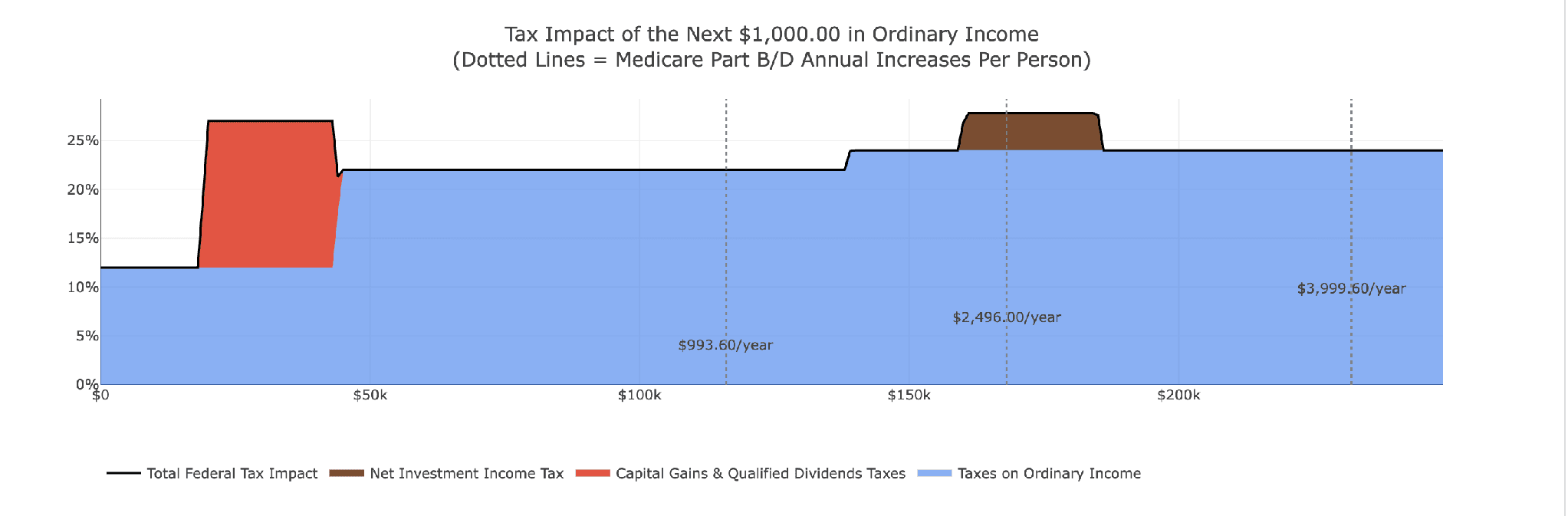
The additional $135,000 of taxable income, on top of Jane’s wage income plus some capital gains income, pushed them through the initial IRMAA surcharge bracket. You can see that on Chart 1 below. As you look at the chart, $0.00 represents their income without the Roth Conversion. In other words, the chart helps us understand the tax impact of each additional dollar of ordinary income.
Chart 1: Analyzing Taxes for the Next $1 of Income
Source: Trailhead Planners, Holistiplan
As you can see, a $135,000 Roth Conversion, when added to their other income, fills the 12% and 22% federal tax brackets but does not reach the 24% bracket. Additionally, it pushes their income above the first IRMAA threshold.
Here’s the kicker. Because they were 62, they weren’t going to go on Medicare until age 65, three years later. So, their initial Medicare premiums for Parts B and D would be based on their 2023 taxes, not 2022.
In other words, it made sense for us to go big in 2022. In 2023, we paid closer attention to the IRMAA threshold and targeted a Roth Conversion amount that kept them below the first IRMAA tier, so that when they opted into Medicare in 2025, they wouldn’t be charged a higher premium.
Smart, right?
So here’s the takeaway: If you end up retiring in your early 60s, you may benefit twofold from higher Roth Conversions.
First, the earlier the Roth Conversion, the better. This is due to compounding. The earlier you can get money into a Roth IRA, the more time it has to compound and grow tax-free. Tax-free growth leads to tax-free withdrawals for you or your heirs later – potentially decades later – in life. That’s a huge win.
Second, pushing through an IRMAA tier isn’t relevant and will not affect your Medicare premiums as long as neither spouse will be in Medicare in two years. If one spouse is older, their premiums are based on joint income.
Though it is outside the scope of this post, if you’re buying health insurance through the ACA marketplace before 65, conversions may reduce your premium subsidies, which is another reason to model this carefully.
Scenario #2: Go Up to IRMAA or Beyond?
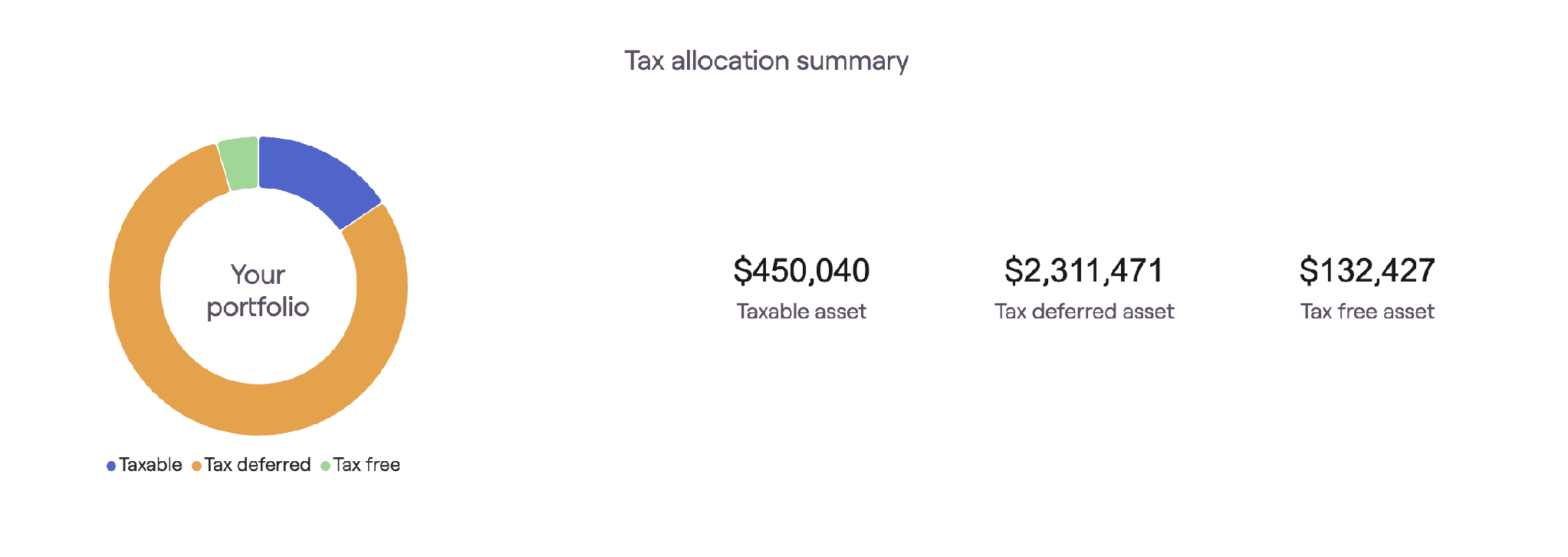
Lisa and Ann are married and live in Minnesota. Lisa is 63 and retired. Ann is 54 and still working, but she plans to retire in two years. Ann is also receiving distributions from a beneficiary IRA from her deceased father. Their investable net worth is about $2,900,000, and the bulk of their investments are in tax-deferred vehicles, like Traditional IRAs.
Because of the beneficiary IRA required minimum distributions and continued wage income, it hasn't made sense to enact Roth Conversions yet, but we plan to once Ann retires in two years. In a recent meeting, we ran the numbers on Roth Conversions. Is it worth doing bigger conversions even if it triggers an IRMAA surcharge and higher Medicare premiums?
During our analysis, we reviewed the following scenarios:
Processing Roth Conversions up to, but not over, the first IRMAA tier reduced their lifetime taxes by $861,305. That’s a really positive result, and there wouldn’t be any Medicare surcharge.
Processing Roth Conversions into the initial IRMAA tier resulted in $963,149 in tax savings over their lifetimes compared with no Roth Conversions. This is set against higher Medicare premiums of $96/month for Lisa initially and for Ann once she reaches Medicare age.
Processing Roth Conversions into the second IRMAA tier resulted in $1,141,459 in tax savings over their lives compared with not doing Roth Conversions. This contrasts with an extra $240/month in Medicare premiums for Lisa. And since only ten years of conversions are proposed, Ann won’t be dinged with higher premiums for more than two to three years in addition to Lisa’s higher premiums.
In their situation, Roth Conversions into the second IRMAA tier are advantageous. Compared with Scenario 1, they are projected to save an additional $280,154 in taxes while paying only about $28,800 in surcharges for Lisa and up to $8,640 for Ann. So, $280,154 of additional benefits versus $37,440 of costs. That’s a 7-to-1 ratio. Pretty good! (Please note that surcharge figures are in today’s dollars and are adjusted for inflation each year.)
In Lisa and Ann’s scenario, the math favors Option 3, but Option 1 is still a strong result even if they decide to surcharge as much as possible.
One thing to keep in mind with Roth Conversions is that the tax savings come toward the end of life. Higher IRMAA premiums are likely during the initial years of processing Roth Conversions. In other words, you’re analyzing a number of factors that are incredibly hard to predict. For example, longevity, or how long you live, matters a great deal. So do future tax rates and IRMAA premiums. All to say, you have to make your best decision with the information you have. In the case of Lisa and Ann, the first option, doing Roth Conversions up to but not over the initial IRMAA tier, is still very advantageous, and you don’t have to deal with higher premiums.
What if I Don’t Do Roth Conversions?
Many retirees skip Roth Conversions or focus too much on IRMAA early in retirement. However, they neglect to acknowledge that when Required Minimum Distributions begin, the IRS will force them to distribute a growing portion of their deferred savings every year, regardless of any other income.
At this point, outside of qualified charitable distributions (QCDs), there aren’t many opportunities to reduce the impact of high RMDs.
High RMDs, along with Social Security income, pension income, investment income, and other sources of income, can trigger IRMAA year in and year out for the rest of a retiree’s life. In short, avoiding IRMAA now may mean paying higher Medicare surcharges later in life.
Last, for married couples, there’s what’s often called the widow’s penalty. After one spouse passes, the survivor usually files as a single taxpayer starting the following year. Their income often doesn’t drop much, especially once the IRAs are combined and RMDs continue. But single filers face narrower tax brackets and IRMAA thresholds that are roughly half as high. Converting while you’re both alive and filing jointly can reduce that future hit.
When It’s Not Worth It
When is it not worth it to pay an IRMAA surcharge due to Roth Conversions?
First, IRMAA is a secondary question. The primary question is whether Roth Conversions make sense for you at all. If they do, great. Do they make sense irrespective of IRMAA surcharges? That’s a tradeoff to consider.
Second, many people dislike paying higher Medicare premiums, regardless of any financial benefits from Roth Conversions. If that’s you, don’t sweat it. If you can and the math works, do Roth Conversions up to the first IRMAA tier, then stop there.
Lastly, for individuals who are ill or don’t expect to live long, Roth Conversions generally don’t make sense. The prospect of paying higher Medicare premiums is another reason to opt out of the strategy.
How Trailhead Approaches This Decision
At Trailhead Planners, our team maps out our clients’ lifetime tax bill and then looks for opportunities—small and large—to reduce those taxes.
Sometimes, you want to pay taxes now to pay less later. That’s the case for Roth Conversions. We map it out, run the numbers, and present our findings to help clients choose the best path forward for their unique goals.
Notably, almost every financial decision involves trade-offs. There’s rarely a free lunch. In the case of Roth Conversions, there are two major trade-offs. You pay taxes now rather than later, which is never fun. And your income may jump into a higher IRMAA bracket, resulting in higher Medicare surcharges.
All to say, we present the good and the bad, the opportunity and the trade-off, and then we set it against the backdrop of their unique financial situation and goals.
Finally, we talk with our clients to finalize the plan and help them implement the strategy.
For example, for a client implementing Roth Conversions, we review their tax plan, determine the appropriate level of Roth Conversion, mindful of marginal tax brackets and IRMAA surcharges, process the Roth Conversion, rebalance investment accounts, coordinate with their tax filing team, and ensure the client is prepared, from a cash flow perspective, for the tax payments from the Roth Conversion and, potentially, for higher Medicare premiums.
FAQ
Does every Roth Conversion trigger IRMAA?
No, not every Roth Conversion triggers IRMAA. For example, in 2026, the first IRMAA tier kicks in at $109,000 MAGI for single filers and $218,000 MAGI for joint filers. Also, as a reminder, your 2026 premiums are based on the income on your 2024 tax return.
All to say, if you completed a Roth Conversion in 2024 and your income remained below those thresholds, you wouldn’t pay a Medicare surcharge.
Can I appeal an IRMAA surcharge?
Yes, you can appeal your IRMAA surcharge if your higher income occurred before a life-changing event. For example, if you earned $130,000 in 2024 as a single filer and retired in January 2025, you would be above the 2026 IRMAA threshold. However, you can file Form SSA-44 with the Social Security Administration to show that you retired or were laid off, which constitutes a life-changing event.
Other life-changing events include: a reduction in work (not just full retirement), marriage, divorce, the death of a spouse, the loss of an income-producing property, the loss or reduction of certain pension income, and an employer settlement payment.
Does converting in a low-income year help?
Yes, processing Roth conversions in an otherwise low-income year helps on two fronts. First, you can convert more of your tax-deferred savings to a Roth IRA at a lower tax bracket. That’s a big win right there. Second, you may trigger less IRMAA, or none at all.
All to say, taking advantage of low-income years to execute Roth conversions is a great strategy to consider on multiple fronts.
Will owning tax-exempt municipal bonds help me avoid IRMAA?
No. Owning tax-exempt municipal bonds will help you avoid federal and, potentially, state income taxes, but tax-exempt interest is added back to MAGI for IRMAA calculation purposes. That means muni interest counts toward the IRMAA thresholds just like taxable interest does. For what it’s worth, muni interest also counts when determining how much of your Social Security is taxable.
How do I forecast what my Medicare premiums will be two years from now?
The tricky part is that you won’t know the exact thresholds when you make the decision. IRMAA thresholds are adjusted for inflation each year and announced in the fall for the following year. So when you do a Roth conversion in 2026, it will be measured against the 2028 thresholds, which won’t be published until late 2027.
In practice, we start with the current thresholds, assume a modest inflation increase, and leave a cushion of a few thousand dollars below the line. That’s especially important because IRMAA works like a cliff. It’s also why we often finalize conversions late in the year, once most of your income for the year is known.
Remember that IRMAA’s version of MAGI includes tax-exempt interest, like municipal bond income. We also model the full picture (conversions, capital gains, Social Security, and other income) with tax planning software before recommending a conversion amount.

Morgan Ranstrom, CFA, CFP®, CEPA®
Morgan Ranstrom is based in Minneapolis, MN, and he is a CFA charterholder as well as a CFP® and CEPA® professional.